Welcome to the School of Architecture!
For first day of class, please be sure to have your computer and course supplies ready. Check in to each of your classes on the Student Portal. If you have any questions, reach out to architecture@academyart.edu
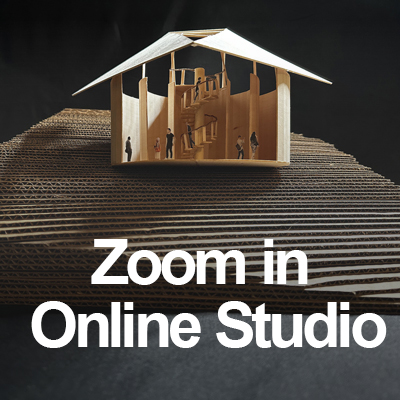
Building a Studio Culture in an online studio class requires your time and effort. Attending weekly live Zoom sessions is the best investment you can make to ensure a successful outcome. Within a robust Studio Culture, architecture students learn not just from their faculty but also from their peers. Build a relationship with your design studio faculty and contribute to the Studio Culture by attending live Zoom sessions each week and posting your work to Conceptboard. Connecting with faculty and peer students through synchronous interactions will enrich your design education in immeasurable and profound ways ultimately leading to a successful transition to the profession.
In online studio classes, students have live interactions with faculty on a weekly basis in synchronous Zoom meetings. There is a strong correlation between Zoom sessions and student success. Receiving live feedback from Studio faculty is the most time-efficient for busy online students. Online students are asked to check in with studio instructors at least once a week via Zoom or view recordings of Zoom sessions.
A note on Credit Hour Requirement: The Department of Education requires universities to design curriculum so that a student spends 9 hours (minimum) per week to earn 3 college credits. Page 5 of this document shows the federal definition for Credit Hour. Architecture courses require significantly more hours than the minimum.
Architecture courses are fast-paced so missing more than a week of class will make it challenging to get caught up. If absences longer than one week is anticipated, students are advised to postpone enrolling in architecture studio courses.
ARH 110 Studio: Concept and Form (3 credits) – Please dedicate 18 hours minimum per week
ARH 150 Studio: Space and Ordering (6 credits) – Please dedicate 36 hours minimum per week
ARH 255 Studio: Context and Narrative (6 credits) – Please dedicate 36 hours minimum per week
Your success in an online studio class relies heavily on the effort you make to communicate with faculty. Make it a priority to regularly dialogue with your faculty EACH week during the semester by attending weekly Zoom sessions (many questions get asked and answered there). Correspond with your faculty regarding any challenges or questions you may have in completing your work. Don’t be afraid to ask questions especially if you are unclear on expectations. Questions count as participation, and everyone in your class will benefit from your questions!
The ARH Blog (this website) is our virtual hub for sharing important information and exciting announcements. This frequently updated website offers valuable resources and is a great way to get to know the ARH community. Find resources specifically for new students, faculty bios, student work, alumni stories, scholarship opportunities, architect license requirements, resume and portfolio advice, community based design projects, university and department policies, and much much more!
Please bookmark your browser: https://architecture.academyart.edu
To successfully complete architecture courses, students must have a computer meeting the Minimum Computer Specifications (click on button below).
For first day of online classes, a computer with a webcam, a microphone, and a mouse is required. A reliable internet connection is also essential. Chromebooks, tablets, mobile devices are NOT sufficient for architecture classes and not substitutes for a computer. A computer set up with two monitors is highly recommended – at least one monitor must be 27 inches or larger. If using a laptop, a larger separate monitor is required.
Undergraduate students purchasing a new computer should choose PC over Mac. In upper years, undergraduate students need to use software, Revit, that is optimized for PC.
A digital camera or a smartphone is needed to photograph drawings and models so that you can submit your work each week.
Students who do not yet have a high-powered computer and internet connection are advised to postpone enrolling in architecture courses. Non-architecture courses, such as Liberal Arts general education courses can be taken while the required computer is being procured.
- Rhino 3D from McNeel is industry standard software that is used in all years of the architecture program. McNeel offers deeply discounted student pricing for a perpetual license. This is a one-time purchase and not an annual subscription. This means you do not have to purchase it every year and you can continue to use it after graduation. McNeel also offers a 3-month free trial.
- Zoom is available at no additional cost. Please install the app (or update) before first day of class. We recommend installing the app on your mobile device as well.
- Adobe Creative Cloud (Photoshop, Illustrator, InDesign) is available to all registered students at no additional cost – Create an account at Adobe.com using your academyart email address.
- Conceptboard is used in all online studio classes. There is no additional cost. You do not need to create an account. Join as “guest.”
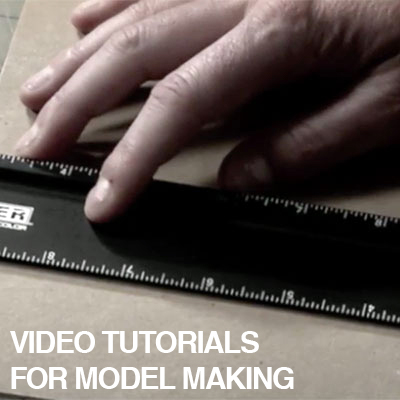
Supplies for ARH 110 Studio: Concept and Form and ARH 170 Design Communication 1 overlap so you do not have to purchase anything twice. ARH 110 requires additional tools and materials for physical model-making. Please check your courses for the FULL list of supplies for each class.
See the list below if you are waiting for financial aid and can only purchase a partial list of supplies during the first two weeks of classes. You will need the items listed below on your first day of class. As funds become available, you can purchase the full list of supplies.
Blick item numbers are listed for reference, but items can be purchased from any retailer.
20442-2041 CretaColor Monolith Woodless Pencil 4B (any brand)
10322-1023 Sketch Book, 9″x12″, 100 sheets (any brand, any binding, 5″x7″ size is also okay)
24153-1005 Blick Drafting Tape 1/2” x 60 yds (any brand) Non-permanent removable adhesive tape
10530-1218 Blick Studio Tracing Rolls 18″ x 50 yds White (any brand)
55709-1012 Staedtler Triangular Scale 12″, Architectural (any brand)
12731-1030 3M Scotch Postal Wrapping Paper – 30″ x 15′ roll – For Body Tracing assignment in module 1. Can be substituted with a blank side of gift wrap paper in similar widths
21316-2001 Sharpie Marker (any brand, black or dark color, fat tip) – For Body Tracing assignment in module 1
20098-1049 Crayola Washable Sidewalk Chalk – Asstd Colors, Set of 4 (any brand) – For Body Tracing assignment in module 1
*Note: Students in the in-person section of ARH 110 will be provided with Brown craft paper and markers for the Body Tracing assignment in module 1.
Blick item numbers are listed for reference, but items can be purchased from any retailer.
58991-1009 Blick Cutting Mat Translucent 18″X24″ or larger (any color, any brand)
55489-1018 Westcott C-Thru Flexible Stainless Steel Ruler, 18″ (any brand)
57445-1101 X-Acto #1 Knife (any brand)
57558-1105 X-Acto #11 Blade, Stainless Steel, 5 pk (any brand)
23887-1007 Elmers Glue All/7.625OZ (or any white craft glue)
13145-3146 Utrecht Chipboard – 29″ x 46″, 0.031″ thick (any brand)
13900-3040 1/8” thick Corrugated Cardboard (any brand). It is not necessary to purchase this new if you are able to repurpose used boxes. Recycled cardboard is acceptable if it is in good condition and correct thickness.
Here are links to information helpful for new students. Please click on the images.