
Congratulations to Daniel Choi who has won the AIA California Urban Design Student Award!
Jury notes:
The jury admires how the designers used very strategic interventions to improve the usability of small urban open spaces that are critical to communities. The design is eloquently intentional, specific to and forming from all of the sustainability and resiliency goals, and it addresses human comfort and the importance of shade in an interesting and compelling way. They did a great job at listening to the site and existing buildings, expressing innovative ideas on integrating community, equity and sustainability with long term resiliency.
Oakland’s Fruitvale neighborhood faces two urgent realities: a community underserved by quality public space and a buried creek with an underground culvert that risks failure from emergent groundwater as sea levels rise toward six feet by 2100-2320. This project responds to both conditions simultaneously – daylighting Sausal Creek as socio-ecological infrastructure that serves the neighborhood year-round while preparing it for the climate pressures of the coming century.
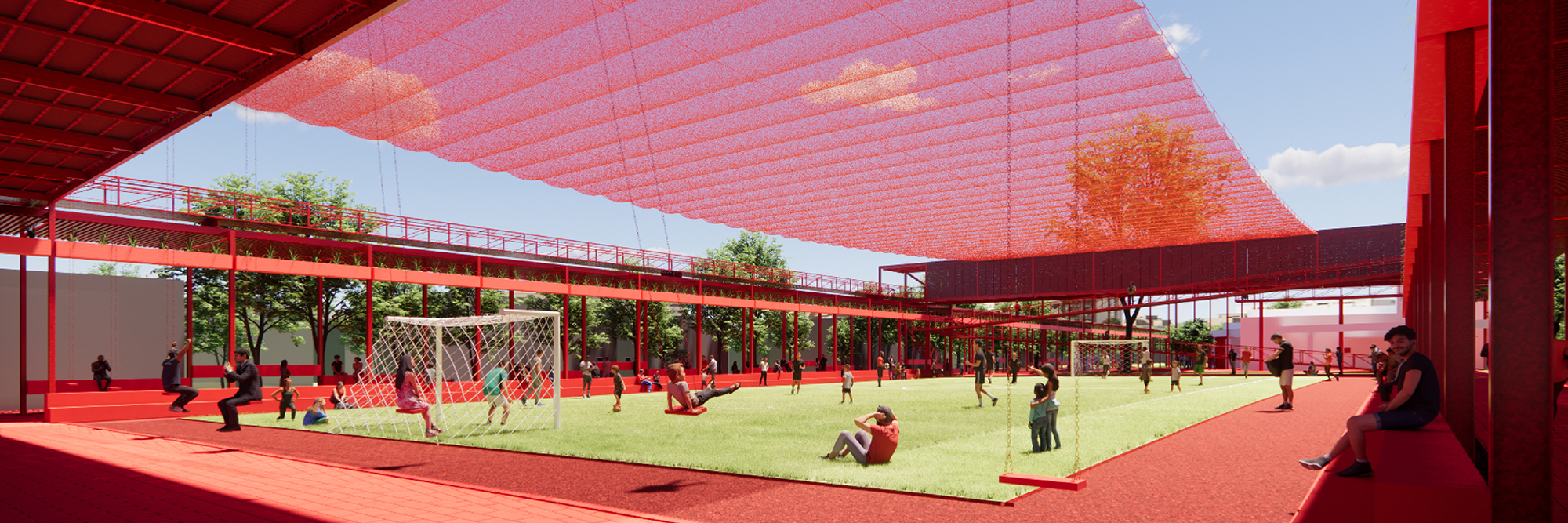
The design introduces a large-scale civic infrastructure that extends the existing Carmen Flores Recreation Center across the full breadth of José de la Cruz Park. The building’s elevated canopy – clad in building-integrated photovoltaics and perforated metal – shelters an expansive public ground plane organized into two seasonal modes. The Sausal Creek is daylit.
During dry months, the structure operates as a community hub: shaded plazas for gathering and performance, a central soccer field, terraced children’s play areas, and elevated walkways connecting across the daylighted creek below. A closed-loop greywater network feeds tiered planters and an overhead sprinkler system, establishing a self-cooling microclimate.
During the wet season, the ground plane transforms into a floodable retention and bioretention system that manages stormwater, filters runoff, controls erosion, and increases local biodiversity. The project demonstrates that climate infrastructure need not be invisible or utilitarian. By bringing a once-buried creek back to the surface and housing ecological performance within a bold civic infrastructure, it builds long-term resilience for one of Oakland’s most vulnerable communities – not beneath their feet, but at the center of their neighborhood.
Faculty: Diego Romero Evans